How to Become a Personal Trainer in Nepal — Complete Guide 2026
How to Become a Personal Trainer in Nepal — Complete Guide 2026
The fitness industry in Nepal is one of the fastest-growing professional fields in the country. New gyms are opening across Kathmandu, Lalitpur, and Pokhara, corporate wellness programs are expanding, and demand for qualified, certified personal trainers has never been higher.
But here is the question most aspiring fitness professionals ask: how do you actually become a personal trainer in Nepal, and how do you do it in a way that opens real career doors?
This guide covers every step, from understanding what personal trainers do to earning your certification and building a client base. If you are serious about a professional fitness career in Nepal, this is your complete roadmap.
If you want to understand earning potential before you start, read: Personal Trainer Salary in Nepal (2026 Guide).
What Does a Personal Trainer Actually Do?
Before committing to a training pathway, it helps to understand what the job involves.
A professional personal trainer does far more than count reps or design workout programs. A certified personal trainer:
- Conducts client assessments covering movement quality, health history, lifestyle, and goals
- Designs individualized exercise programs based on evidence-based principles
- Coaches clients through sessions by cueing movement, correcting form, and progressing load
- Tracks client progress and adjusts programming over time
- Provides basic nutrition guidance within the scope of practice
- Builds professional relationships that keep clients consistent
In Nepal, personal trainers work in commercial gyms, boutique fitness studios, corporate wellness programs, sports academies, online coaching, and private training. The field offers a wide range of income models, from fixed gym salaries to fully independent practice.
Step 1: Understand the Requirements
There are no government-mandated prerequisites to start training as a fitness professional in Nepal. The requirements set by internationally recognized certification bodies like NASM are straightforward:
- Age: 18 or older
- Education: High school diploma or equivalent (SLC/SEE or above)
- No prior fitness experience required: programs are designed to take you from beginner to certified professional
What matters most is your commitment to learning the science and developing coaching skills through structured practical training.
Step 2: Choose the Right Certification
This is the most important decision in your fitness career. The certification you earn determines where you can work, how much you can earn, and whether your qualification is respected internationally.
There are two main certification pathways available to aspiring trainers in Nepal:
TFA-NAES Certified Personal Trainer Course
The TFA-NAES Certified Personal Trainer Course is Nepal's own internationally affiliated CPT program, delivered by NAES Nepal (Nepal Academy of Exercise Science), the official NASM International Education Partner in Nepal. The curriculum covers exercise science, client assessment, program design, and practical coaching, and is approved for NASM, ACE, and AFAA continuing education credits internationally.
This is the recommended starting point for most students in Nepal. It is specifically designed to take beginners through to certified professional over 3 months.
NASM-CPT: The International Gold Standard
NASM-CPT (Certified Personal Trainer) is the world's most recognized personal training certification, held by over 1.9 million professionals in 100+ countries. NASM is directly accredited by the NCCA (National Commission for Certifying Agencies), the highest standard in fitness certification accreditation.
The NASM curriculum is built on the OPT (Optimum Performance Training) model, a systematic framework covering corrective exercise, foundational strength, and power training. For Nepali trainers planning to work in the UAE, Qatar, Australia, or the UK, NASM-CPT is the single most recognized credential in those markets.
Why the Academy You Choose Matters
A certification is only as credible as the institution issuing it. In Nepal's fitness education market, many academies use NASM or ACE logos in their marketing without holding official partnership status with those organizations.
Before enrolling in any program, verify the academy's official partner status directly on the certification body's website. NAES Nepal is Nepal's only officially verified NASM International Education Partner, confirmed and publicly listed at nasm.org/resources/international-partners.
For a full comparison of certifications available in Nepal, read: NASM vs ACE vs EREPS — Best PT Certification Nepal 2026.
Step 3: Enroll in a Certified Fitness Academy in Nepal
Once you have decided on a certification pathway, the next step is choosing where to train.
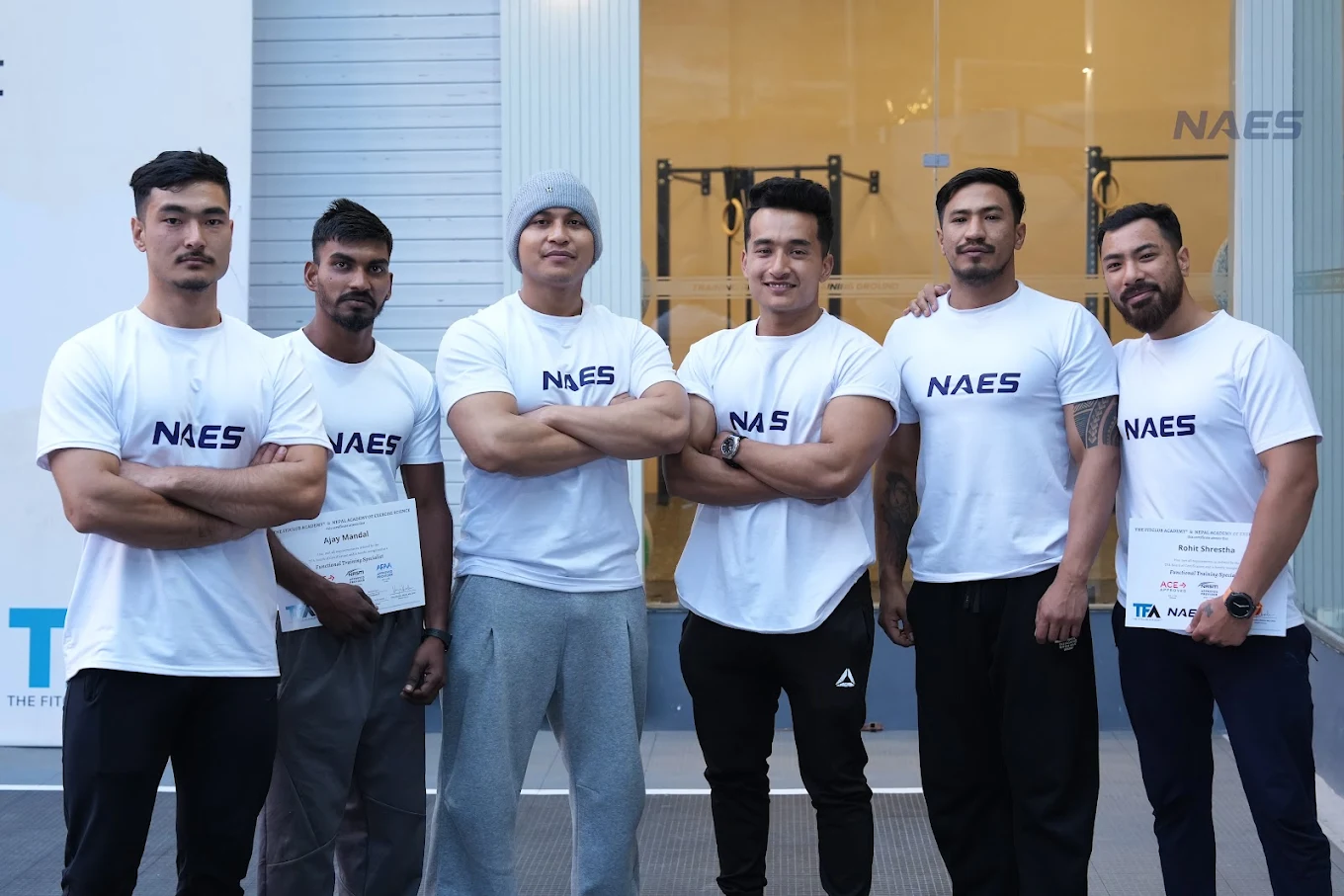
NAES Nepal in Baluwatar, Kathmandu, is Nepal's leading fitness academy and the only official NASM partner in the country. Programs are available in three formats:
- Online (100%): Self-paced with lifetime access, available anywhere in Nepal
- Onsite: In-person at Baluwatar, Kathmandu
- Hybrid: Online theory combined with in-person practical components
For students outside Kathmandu, including those in Pokhara, Chitwan, Butwal, or Biratnagar, the online format means geography is no longer a barrier to internationally recognized fitness education.
What to look for in a fitness academy:
- Officially verified NASM/ACE partnership status (verifiable on the organization's website)
- Curriculum built on internationally recognized standards
- Instructors who hold verifiable CPT credentials
- Practical coaching components, not theory-only
- Career support after certification
For a detailed checklist of what to verify before enrolling, read: How to Choose a Fitness Academy in Nepal.
Step 4: Complete Your Training
The Certified Personal Trainer Course at NAES runs approximately 3 months (12–15 weeks). During this period, you will cover:
Anatomy and Exercise Physiology: The foundational science of how the body moves, adapts to training, and recovers.
Client Assessment: How to assess movement quality, health history, lifestyle factors, and goals to design appropriate programs for different client populations.
Program Design: Applying the OPT model to design systematic, progressive training programs for beginners, weight loss clients, and performance-focused athletes.
Coaching Technique and Communication: How to cue exercise correctly, correct form in real time, and build the client relationships that lead to long-term retention.
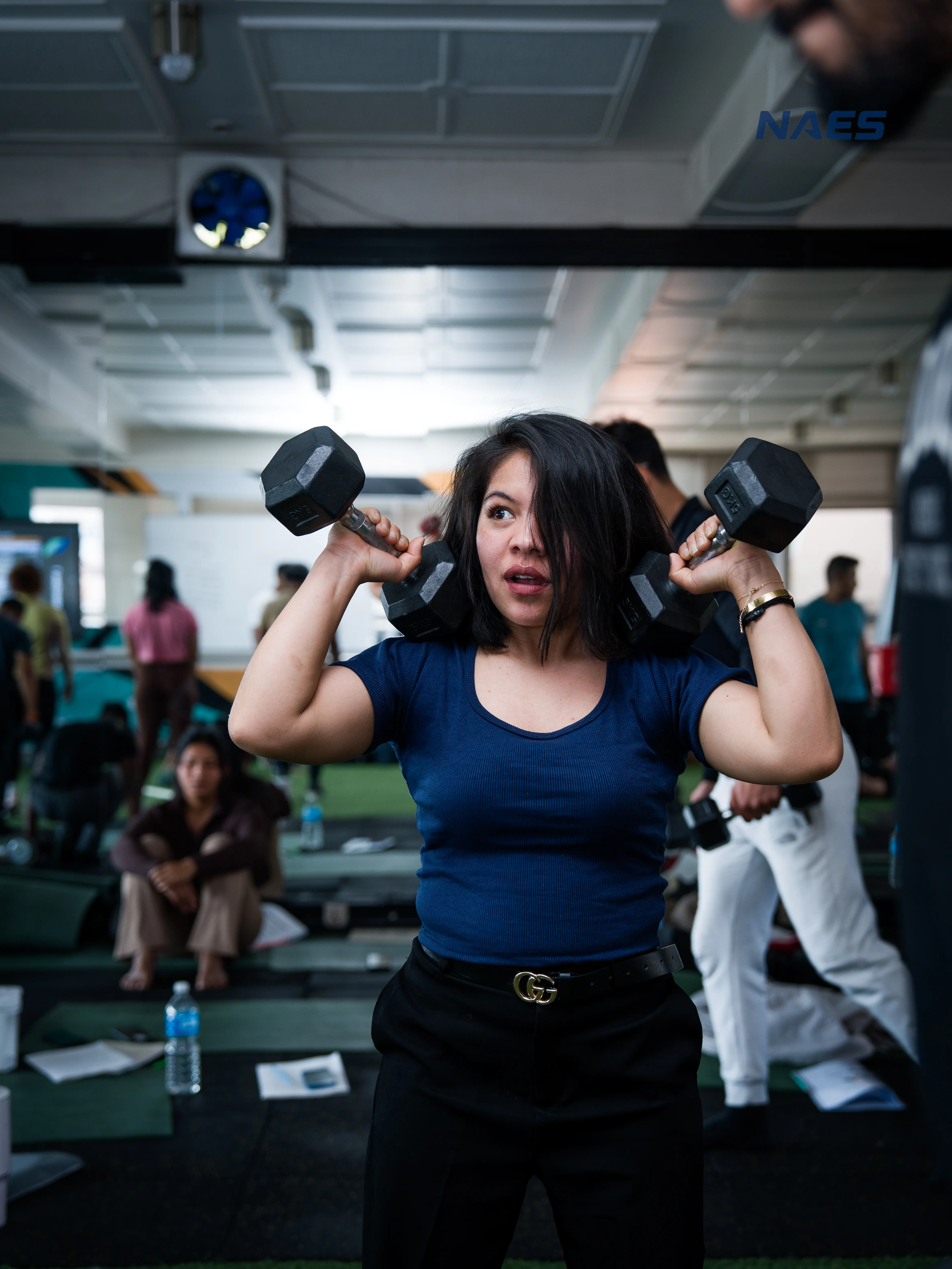
Practical Coaching Sessions: Supervised sessions where you apply your knowledge training real clients under instructor guidance. This is where theory becomes skill.
Nutrition Fundamentals: Evidence-based nutrition principles within personal trainer scope of practice.
Business and Professional Practice: How to set up, market, and manage a personal training career across gym employment, independent practice, or online coaching.
Step 5: Pass Your Certification Exam
Most certification programs include a final assessment administered by the certifying body.
For the TFA-NAES CPT, assessments are module-based and completed throughout the course rather than in a single high-pressure exam. For NASM-CPT, the exam is administered directly by NASM.
Tips for exam success:
- Study consistently throughout the program, not just at the end
- Use practice questions to identify weak areas early
- Review anatomy, the OPT model, and client assessment protocols thoroughly
- Attend all practical sessions, as hands-on experience reinforces theoretical knowledge
Your NAES instructors provide guided preparation and lifetime tutoring support throughout.
Step 6: Build Your Career
Certification opens the door. What you do next determines how far your career goes.
Working at a Gym
Entry-level certified trainers typically start at commercial gyms, earning NPR 18,000–30,000/month as floor trainers or group class coaches. This phase builds real-world experience, client relationships, and professional confidence.
Premium gym facilities in Nepal and internationally increasingly require internationally recognized certifications when hiring. Your NASM-CPT or TFA-NAES credential positions you ahead of uncertified applicants.
Building an Independent Practice
Many trainers eventually transition to independent practice, training clients directly in-person or online. Independent personal trainers in Nepal with an established client base earn NPR 60,000–150,000+ per month.
Online Coaching
Online coaching has become a major income stream for Nepal-based trainers. Serving clients across Nepal and internationally, online coaches earn scalable income independent of location. A 3-month package at NPR 25,000+ per client, with 10–15 clients, represents substantial monthly income.
For a complete breakdown of earning potential at every career stage, read: Personal Trainer Salary in Nepal (2026 Guide).
Step 7: Add Specialist Certifications to Grow
Once you hold your foundational CPT, specialist certifications expand both your skills and your earning potential. NAES Nepal offers the most complete range of specialist programs in Nepal:
NASM-CPT is the world's most recognized personal training certification. If you completed the TFA-NAES CPT, this is the natural international upgrade, giving you the NASM credential recognized by employers in 100+ countries.
Functional Training and Strength Coach Certification covers movement-based training, functional assessment, corrective exercise, and strength programming for performance and injury prevention.
Women's Health and Fitness Specialist focuses on female physiology, hormonal health, and pre and postnatal fitness. It is a growing specialization as gyms increasingly seek coaches with specific women's health expertise. To understand the physiological principles behind this specialization, read Women's Training vs Men's Training: What the Biology Actually Says.
NASM Corrective Exercise Specialist (NASM-CES) covers advanced movement assessment and corrective exercise programming. It is highly valued for working with athletic populations and rehabilitation clients.
NASM Certified Sports Nutrition Coach (NASM-CSNC) covers sports nutrition, dietary planning, body composition, and sustainable lifestyle coaching, opening nutrition coaching as a standalone income stream.
NASM Physique and Bodybuilding Coach (NASM-PBC) covers hypertrophy training, contest preparation, and peak week strategies for physique and bodybuilding coaching.
Each specialization adds a marketable, verifiable credential to your professional profile. Most successful trainers in Nepal hold 2–3 certifications within 3–5 years of starting their career.
Common Challenges and How to Navigate Them
"I don't know where to start." Begin with the TFA-NAES Certified Personal Trainer Course. It is designed for beginners with no prior formal training background. You do not need to know anatomy or programming before you enroll. That is what the course teaches you.
"I'm worried the certification won't be recognized." Enroll only with a verified institution. NAES Nepal is Nepal's only officially listed NASM International Education Partner, confirmed on NASM's public directory. Graduates receive credentials recognized by employers in Nepal and internationally.
"I live outside Kathmandu." Every NAES program is available 100% online with lifetime access. Students from Pokhara, Chitwan, Butwal, and across Nepal complete their certifications without relocating. Contact NAES to discuss which format works for your situation.
"I'm already working and can't attend fixed classes." NAES offers flexible online formats with self-paced modules, so you study around your existing schedule, not the other way around.
"I don't know if personal training is a viable career." Nepal's fitness industry has grown significantly over the past five years and continues to expand. Certified personal trainers build strong, sustainable incomes. The key factors are certification quality, specialization, and business development. For the full picture, read: Personal Trainer Salary in Nepal (2026 Guide).
Start Your Career at NAES Nepal
NAES Nepal is Nepal's only official NASM International Education Partner and the single verified pathway to internationally recognized fitness certification in the country.
- View the Certified Personal Trainer Course: NAES's foundational 3-month program
- Explore NASM certifications in Nepal: NASM-CPT, CES, CSNC, PBC
- See all programs at NAES Nepal: the complete certification pathway
- Contact NAES Nepal to ask about upcoming batch dates and formats
Kalyon Building, 3rd & 4th Floor, Baluwatar, Kathmandu 9744441400 | 9863387095
Frequently Asked Questions
What qualifications do you need to become a personal trainer in Nepal?
You need to be 18 or older with a high school diploma (SLC/SEE or equivalent). No prior fitness experience or university degree is required. NAES Nepal's programs are designed to take complete beginners from foundational knowledge to certified professional in approximately 3 months.
How long does it take to become a certified personal trainer in Nepal?
The TFA-NAES Certified Personal Trainer Course takes approximately 3 months (12–15 weeks). The NASM-CPT duration varies based on self-paced study. Specialization programs range from 2 weeks to 4 months.
What is the best personal trainer certification in Nepal?
NASM-CPT is the world's most recognized personal training certification and the strongest credential for international career mobility. The TFA-NAES CPT is Nepal's own internationally affiliated foundational program, recognized for NASM, ACE, and AFAA continuing education credits. Both are available at NAES Nepal, Nepal's only official NASM partner.
How much does it cost to become a personal trainer in Nepal?
NAES program fees range from NPR 15,000 to NPR 110,000 depending on the certification. Contact NAES directly at 9744441400 for current pricing on specific programs.
Can you become a personal trainer without a degree in Nepal?
Yes. A university degree is not required. NAES Nepal's programs require only that applicants are 18 or older with a high school diploma equivalent. The courses teach everything from exercise science fundamentals to advanced program design and practical coaching.
Is NAES the best place to get certified as a personal trainer in Nepal?
NAES Nepal (Nepal Academy of Exercise Science) is Nepal's only officially verified NASM International Education Partner, confirmed on NASM's public international partner directory. It is the only fitness academy in Nepal where you can earn a direct NASM credential alongside a TFA-affiliated foundational program.
What is the salary of a personal trainer in Nepal?
Entry-level certified trainers earn NPR 18,000–25,000/month. Certified professionals with 1–3 years of experience earn NPR 40,000–80,000/month. Independent trainers and online coaches with established client bases earn NPR 100,000+ monthly. For a full breakdown, read: Personal Trainer Salary in Nepal (2026 Guide).
Can I become a personal trainer online in Nepal?
Yes. All NAES programs are available 100% online with lifetime access to course materials. Students from Pokhara, Chitwan, Butwal, Biratnagar, and across Nepal have completed their certifications through NAES's online format without relocating to Kathmandu.
What specialist certifications can I add after becoming a personal trainer in Nepal?
After your foundational CPT, specialist certifications available at NAES Nepal include: NASM-CPT, Functional Training and Strength Coach Certification, Women's Health and Fitness Specialist, NASM-CES, NASM-CSNC, and NASM-PBC. Each specialization adds verifiable, marketable expertise to your professional profile.
Ready to turn this knowledge into a career?